Spotlight on WLL Partners in Africa

Did you know that our community spans over 120 countries, with some of our main work happening across Africa? We set up World’s Largest Lesson Africa to collaborate with some of our key partners in Nigeria (with DEAN Initiative), in Kenya (with SteamLabs Africa) and Francophone Africa (with FORAM Initiatives). Together, we work to bring the SDGs into more classrooms and communities, as well as support educators to embed sustainability into their teaching and learning. Keep reading this blog if you’re interested to learn more! 

DEAN Initiative (Nigeria)

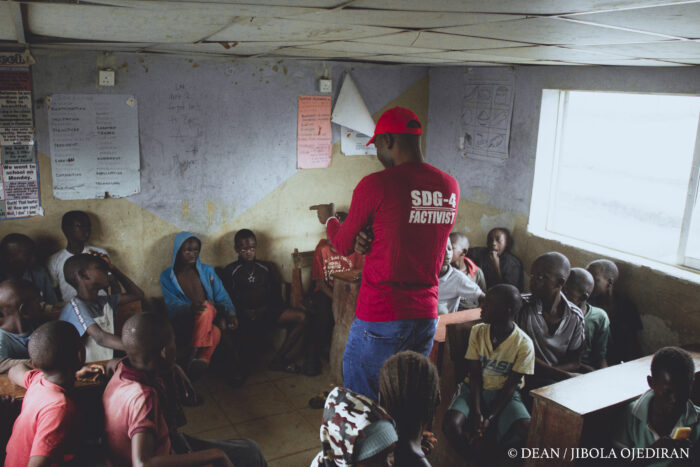
DEAN’s mission is to empower young people with the confidence and leadership skills they need to become agents of change in their communities. This is achieved through direct youth engagement and student voice, or through upskilling teachers and redesigning curricula in line with the Transforming Education mission.
Examples of projects:

  • Transforming Education Survey: DEAN played an instrumental role in helping us gather the views of students in Nigeria and how they felt about their current education. Together, we reached more than 10,000 students.
  • NextGen Teacher Toolkit: Most recently, WLL and DEAN collaborated to create a comprehensive teacher capacity building programme, focused on inspiring teachers to rethink their approach to learning and embrace more impactful, relevant and holistic practices grounded in sustainability education (ESD). The programme will be delivered in the form of Bootcamps, starting with 300 teachers in Abuja, Lagos and Enugu states.
  • Hygiene Education: DEAN led a water, sanitation and hygiene (WASH) campaign, where they delivered hygiene education to 90,000 students in over 200 schools across the country. 

Impact numbers: We launched WLL Nigeria in 2018 with DEAN. Through a week-long SDG activation, DEAN reached 1 million students across Nigeria!

STEAMLabs Africa (Kenya)

STEAMLabs Africa seeks to empower the African students, educators and community through STEAM Education.
Examples of projects:

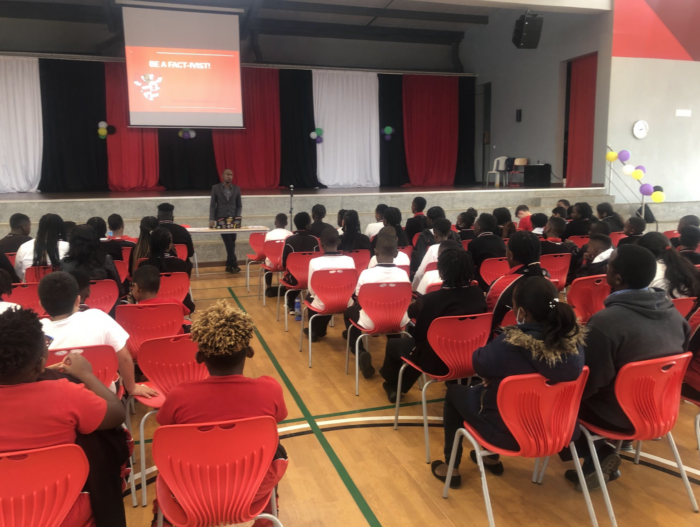
  • Generation Earthshot: Generation Earthshot was an educational project that focused on environmental sustainability. It was delivered to Kenyan educators and students by STEAMLabs Africa in collaboration with WLL, the Earthshot Prize and the Royal Foundation to help learners  develop their creative problem-solving skills using Design Thinking.
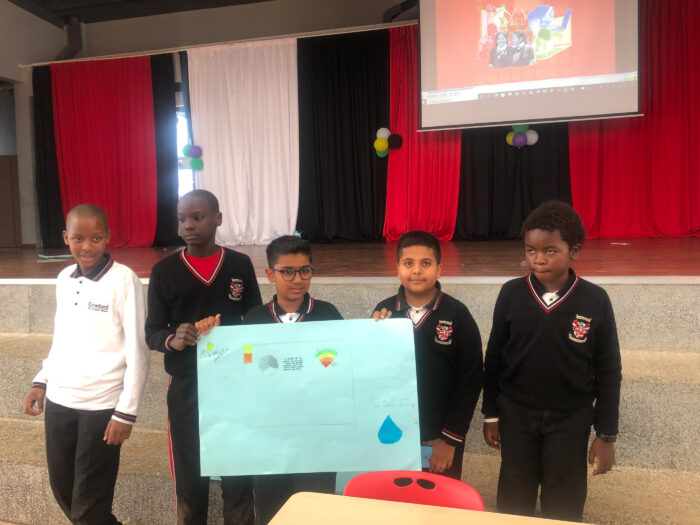
  • Fact-ivism: STEAMLabs supported WLL’s Fact-ivism campaign which saw students dive into the data around the SDGs and use their creativity to visualise key data sets! (link to fact-ivism site)
  • Do Your Bit Challenge: Every year STEAMLabs Africa partners with the do.your:bit organizers to bring this global challenge on SDGs using the Micro:bit kit to encourage learners of ages 8-18 in Kenya to exercise their imagination and combine creativity. The challenge invites learners to identify and research a problem, then design and code solutions using the BBC micro:bit.
  • Teens Innovation Week: In a rapidly evolving world, the Teens Innovation Summit empowers and prepares the next generation of leaders to drive positive change. This groundbreaking event, specifically tailored for teenagers between the ages of 12 and 19, serves as a catalyst for innovation, collaboration, and problem-solving. Bringing together high school students, educators, and experts from various industries, The summit creates a supportive and collaborative environment for self-directed exploration, innovation and communication using STEAM pedagogies, and edTech tools. WLL have featured as guest speakers every year since its inception.

Impact: To date, STEAMLabs have reached more than 60,000 students and 6,200 educators in 80 schools across Kenya.

FORAM Initiatives (Francophone Africa + Cote d’Ivoire)

FORAM Initiative has been a partner of WLL since 2018. Over the years, FORAM’s mission has strongly focused on bringing climate and sustainability education to underserved children and communities across Benin and Togo. Through a strategic approach on non-formal and informal education, FORAM uses sports, chess, art and project-based learning to cultivate young people’s knowledge and skills for action.
Examples of projects:

  • Transforming Education Survey: Through their access to vulnerable and hard-to-reach communities, the team at FORAM was able to bring a voice to some of the most under-served children in Africa. We are proud to have been able to include those critical voices on education in our final report.
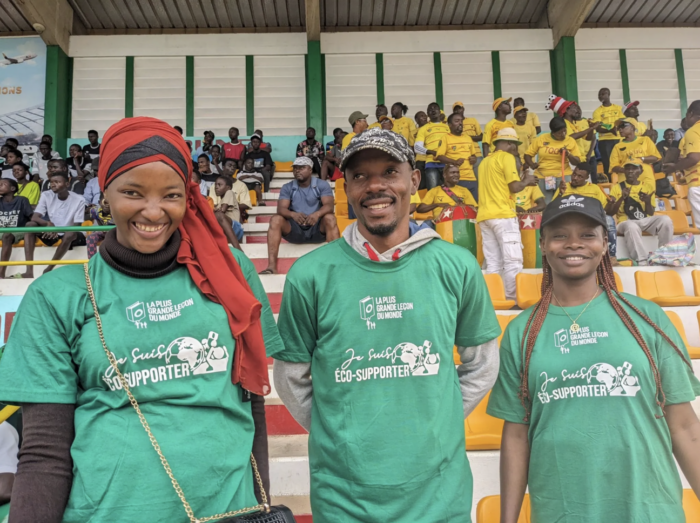
  • AFCON 2023: FORAM led a multi-level and comprehensive climate action campaign during the 2023 Africa Cup of Nations in Cote d’Ivoire. Inspired by our previous Climate Changemakers campaign, FORAM rallied action with Eco-Supporters around stadium clean-ups and plastic recycling, as well as advocacy and awareness on climate action.
  • Artivism: With a view to creating more sustainable habits, FORAM is encouraging circular design thinking in youth by creating opportunities for them to repurpose and transform plastic bottles and waste into art and fashion.

Impact: FORAM’s impact and reach stretches across multiple countries, from local community and school-based activations, to vocational and higher education settings. FORAM is in a unique position to engage and acti

The partnerships forged through the World’s Largest Lesson Africa portfolio demonstrate the powerful impact of collaborative efforts in education. By aligning with DEAN Initiative in Nigeria, STEAMLabs Africa in Kenya, and FORAM Initiatives across Francophone Africa, we are reaching new heights in embedding sustainability within classrooms and communities. These partnerships not only empower educators and students with vital skills and knowledge but also inspire them to become proactive contributors to a sustainable future.
Message from a Wild Bee

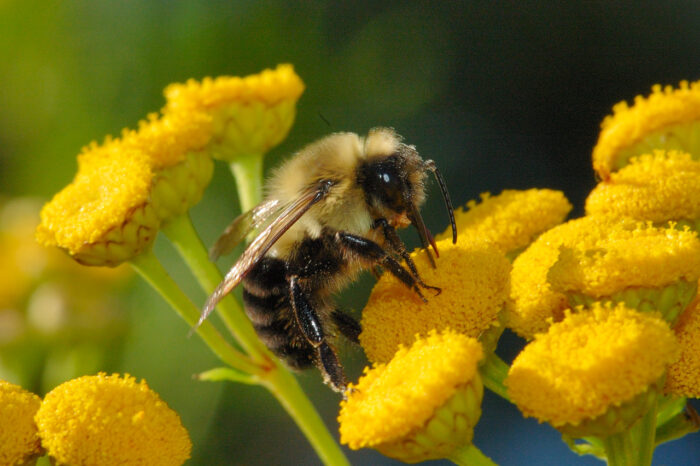
Take a deep breath. Close your eyes for a moment, and imagine you’re shrinking to the size of a bee. Open your eyes. You now have five of them: two big ones on each side of your head, and three smaller ones at the centre of your head, above your antennae. You’re the size of a thumbnail, maybe a little bit bigger. You’ve grown four wings on your back, and an extra leg has sprung on each side of your body, above your hips. 

You’re a wild bee. Not the domesticated honey bee that first comes to mind; there are more than 20,000 species of wild bees in the world. So pick a wild one. You might be a fuzzy bumblebee or a carpenter bee with a shiny black abdomen and beautiful, blue tinted wings. Wild bees are incredibly important – a study conducted in the UK has shown that honeybees provided at most one third of pollination services, with the rest being supplied by wild pollinators. 

You fly out the window and look around. You’re much more aware of the little pockets of nature around you than you normally would be as a human. You notice the trees, and above all the flowers. They’re colourful, and their delicious scents are calling you. You’re looking for pollen or maybe nectar, a sugary substance found in flowers that you like to feed on. You like to eat both – nectar gives you energy, and pollen provides other nutrients such as protein. As you visit a flower to feast on its nectar, pollen grains attach to your body. As you move around, some of these pollen grains get dropped on other flowers. Through this process, known as pollination, these flowers will be able to reproduce and turn into fruits.

Thanks to you, as well as other pollinators such as butterflies, hummingbirds and bats, humans have been enjoying foods as diverse as tomatoes, blueberries, almonds, avocados and cherries for millennia. Without you, they would never have discovered these pleasures. They would not have coffee, nor chocolate. One in every three mouthfuls humans eat depends on pollinators such as bees. 

Humans don’t fully understand you yet, but studies about your kind are starting to emerge. Some scientists have found that bees can demonstrate emotions resembling playfulness and  optimism but also frustration and fear. Some suggest bees can even recognise different human faces, experience PTSD-like symptoms, and process long-term memories. 

Humans don’t understand you, but their activities are hurting you. They spray their fields with harmful chemicals to kill so-called “pests”. These chemicals hurt you. They can even kill you. Because of industrial agriculture, the monocrop fields they are growing with increasing intensity have replaced the thriving ecosystems you used to call home. They are cutting down entire forests to build cities, or to grow even more of the same few plants. Monotonous fields as far as the eye can see. And so wild bee populations are decreasing.

Research has shown that between 25% and 68% of wild bee species in Europe are endangered, depending on the region. And less pollinator diversity results in fewer wild plants, which many other species feed on, from squirrels to sparrows. This can have a ripple effect on entire ecosystems. Goal 15, Life on Land, aims to protect and restore terrestrial ecosystems, and to reverse land degradation and biodiversity loss. None of this can be achieved without diverse and healthy pollinator populations. 

Another deep breath. Back to your human self. So what can you do to help the bees? 

  • Create pollinator-friendly habitats by planting a diverse range of native wildflowers in your garden or on your windowsill
  • If possible, support small-scale, sustainable farmers by buying in season, local, organic food
  • If you find a bee that seems to be struggling, try gently relocating it near a bee-friendly flower. If there are no flowers around you can offer a few drops of water mixed with white sugar on a teaspoon

And you can share this with someone around you to help more humans understand the importance of protecting our precious bees. Happy World Bee Day!

Author: Tiphaine Marie Pittet, Environmental communicator and host of biodiversity podcast Why We Care

Sources: 

https://www.fibl.org/fileadmin/documents/shop/1645-wild-bees.pdf 

https://www.theguardian.com/environment/2023/apr/02/bees-intelligence-minds-pollination  

https://www.wwf.org.uk/learn/fascinating-facts/bees 

https://www.usgs.gov/faqs/do-bees-feed-both-nectar-and-pollen#:~:text=Bees%20feed%20on%20and%20require,and%20nature%20as%20a%20whole 

https://www.youtube.com/watch?v=VSYgDssQUtA&ab_channel=DWPlanetA  


Celebrating the Achievements of the World’s Largest Lesson’s Youth Advisory Panel

Empowering Youth to Shape Sustainable Education

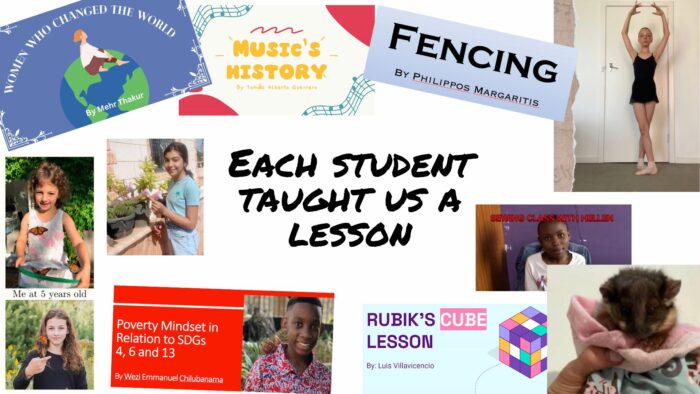
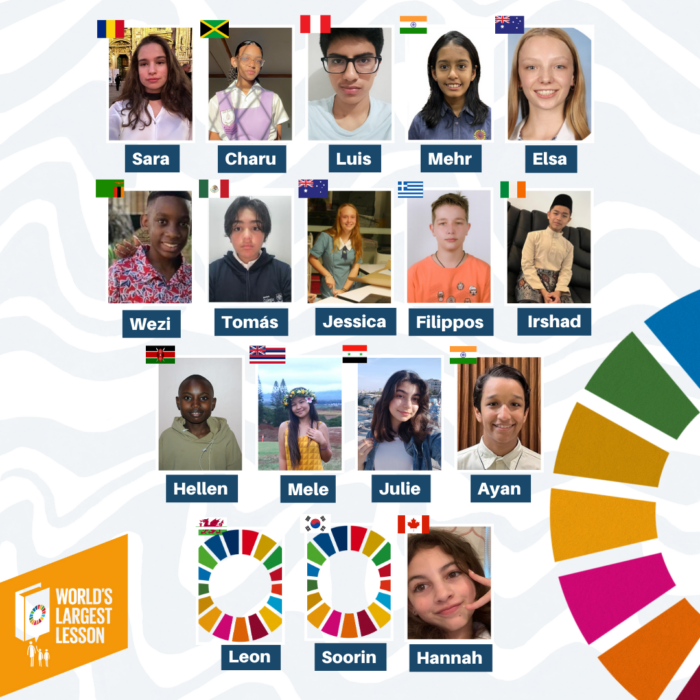
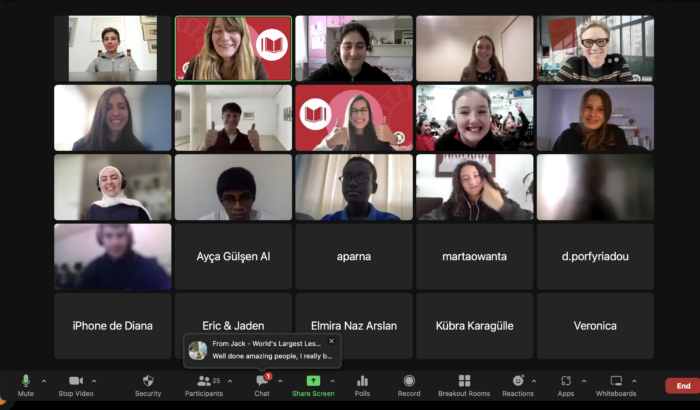
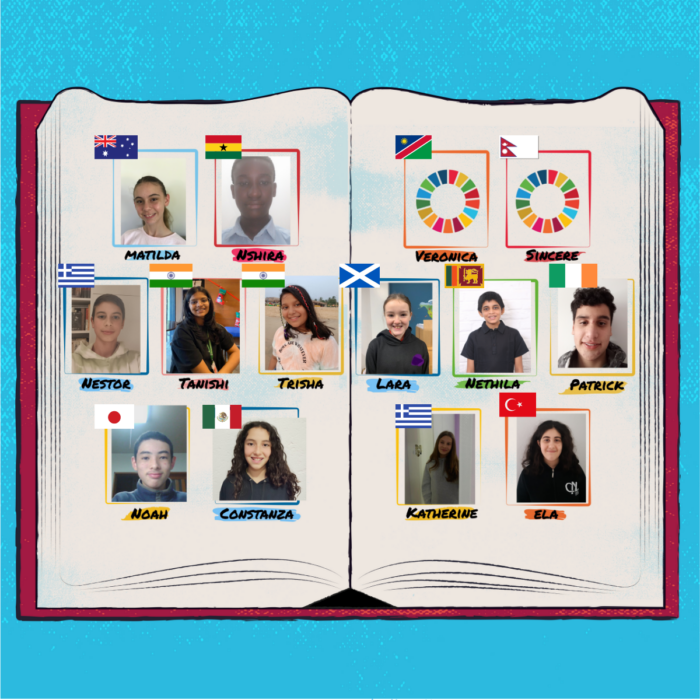
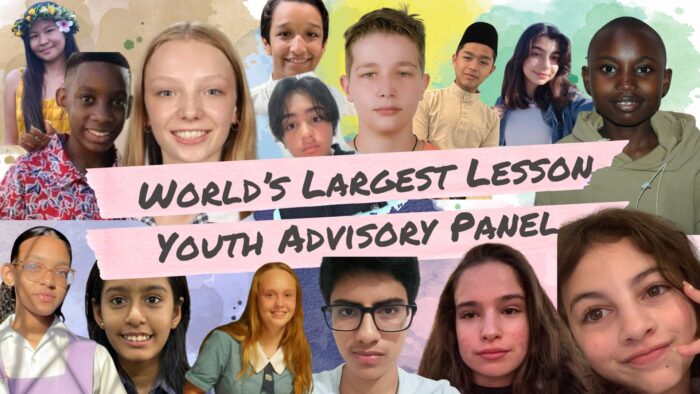
For the past six months, we have been working with 17 students aged between 11-14 years old from 15 different countries to provide their feedback and advice on our work. The experience has been nothing short of valuable, with students of diverse ages and backgrounds sharing their ideas and perspectives on how we can enhance our materials and better meet the minds of amazing students worldwide.

As an organization committed to sustainable development learning, we recognize the importance of involving students at every stage of our campaigns. The Youth Advisory Panel was aimed at giving young people a voice in shaping our work around the Halftime moment for the Global Goals. Through virtual meetings, students shared their thoughts on our existing materials, experienced harnessing the power of data around the Global Goals to drive activism, suggested new topics and activities, provided valuable feedback behind the scenes, and even participated in creating a mood board to shape a lesson plan coming soon.

We were amazed by the quality and depth of their input, which showed a keen understanding of the challenges and opportunities of sustainable development learning. We wrapped up this cohort in April 2024, and had a festive graduation ceremony to celebrate the moment with students and their teachers and family members who have supported their students throughout their participation on the panel.

The impact of this project was significant. It keeps reminding us about the value of involving students in the development process and how their insights can bring new perspectives to the table. They challenged us to think outside the box in terms of how we present our learning materials, and we learned that learners are looking for more hands-on learning that empowers them to take action rather than simply share knowledge on world problems. The project also highlighted the growing importance of topics such as social justice, cultural diversity, gender equality, and climate action to young people.

As for the impact on the students themselves, members of the youth advisory panel found strength in each other as they explored their community’s needs together. They came up with creative plans that matter to all of them. As they move forward, these young people are leading the charge, building a movement that continues to grow and inspire. Their joint efforts create lasting change, making their community a better place for everyone.

The WLL Youth Advisory Panel project has had a remarkable impact on our organization and the future of education. Moving forward, we are excited to continue working with a new Youth Advisory Panel cohort and welcoming new members to the table. We believe that this project has been a great success in empowering young people to shape our work, and we are committed to making it an ongoing initiative. 

Keep an eye on our social channels and our newsletter to be the first to know when the registration for the upcoming panel is open.


Be A Goal #4 Fact-ivist!

We’re very excited to be working with Data Science for Everyone to launch a new challenge!

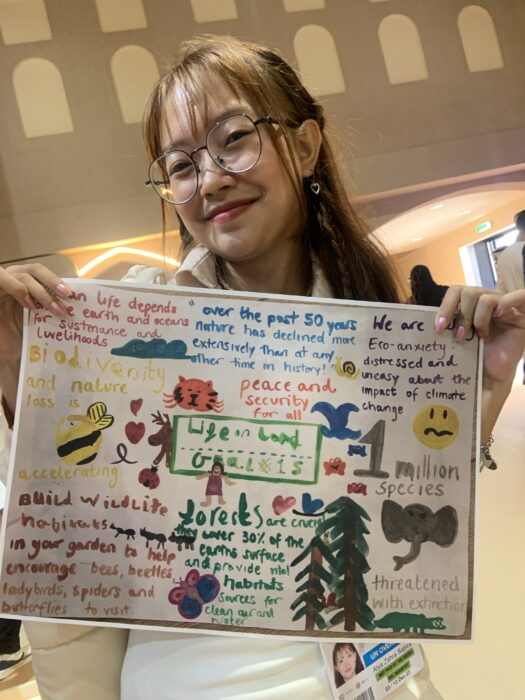
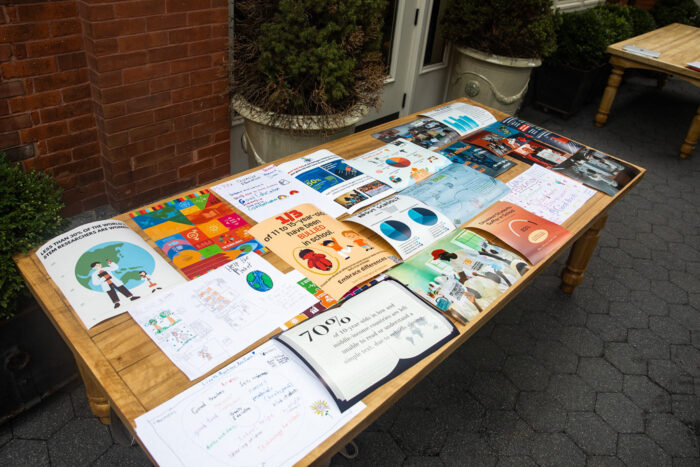
Be A Fact-ivist! is our free online platform inviting students to research data on the SDGs and then share posters using a fact of their choice, because data is the first step to action! 

You can see the online gallery here. The platform is available in English, Arabic, Spanish and French.

On 24th January – International Day of Education – a new challenge is launching! We want to see as many posters as possible from students about SDG #4: Education.

The challenge to students is simple: What do you love about education? What needs to change? Use data to support your argument and bring it to life creatively – then share it with the world!

Everything you need is on the site. There is an option lesson plan, and data to use with statistics on education generated by our Transforming Education Survey of 37,000 students in 150 countries!

Students and teachers can upload cards directly to the website. The Worlds Largest Lesson team will be sharing them on their social media and with education decision-makers, to make change happen.

The competition will close on Open Data Day – March 2 2024.

If your school has share more than 100 cards let us know [email protected]. You’ll be entered into a draw to win some fun Global Goals merchandise and dispay materials for your school!

Click here to get involved

Fact-ivism at COP 28!

This month world leaders headed to Dubai for the UN climate and nature conference COP 28.

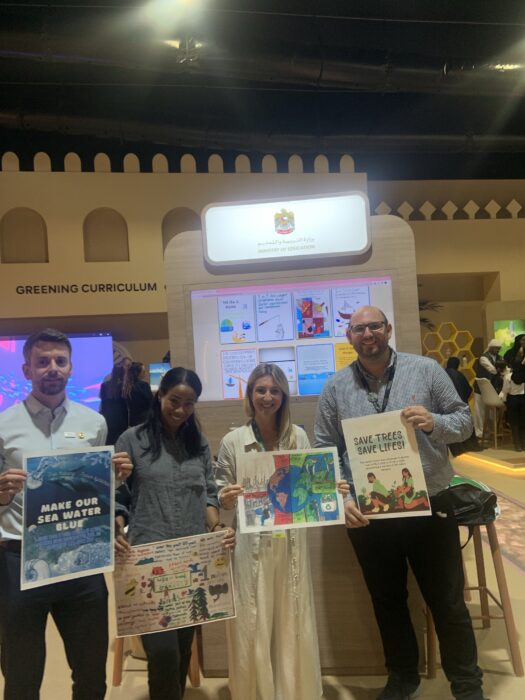
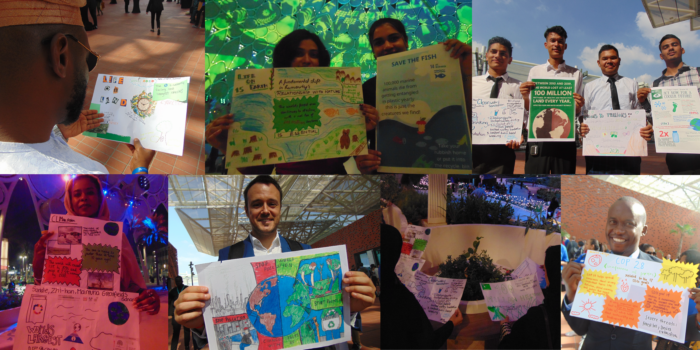
We took students’ Fact-ivism posters from all over the world with us, to share with conference delegates.

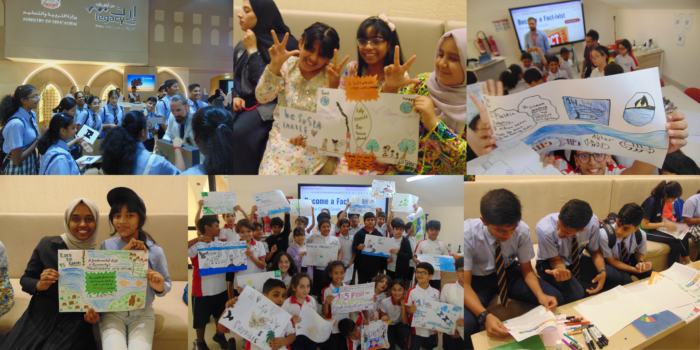
We shared them in the Greening Education Hub with the UAE Ministry of Education, at the RewirED Education Summit, and around the COP site.

Take a look at some of the photos below! 

A BIG thank you to all the students who have shared their posters so far!

You’ve done the hard work, now our job is to share your infographics with the world, to make change happen.

You can share more Fact-ivism posters HERE. So far we have more than 1,000… and counting!

📊🌍🎨✊

The 2023 WLL Youth Advisory Panel: Empowering Students to Shape Our Work

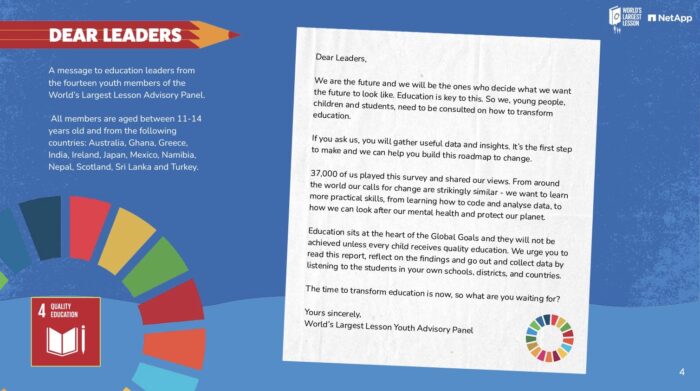
For the past six months, we have been working with  14 students aged between 11-14 years old from 12 different countries to provide their feedback and advice on our work. The experience has been nothing short of valuable, with students of diverse ages and backgrounds sharing their ideas and perspectives on how we can enhance our materials and better meet the minds of amazing students worldwide.

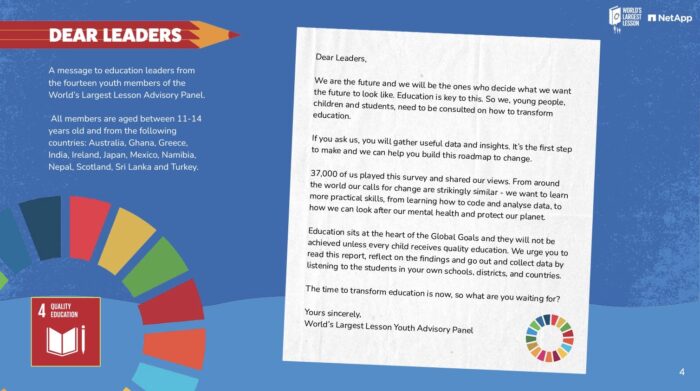
As an organization committed to sustainable development learning, we recognize the importance of involving students at every stage of our campaigns. The Youth Advisory Panel was aimed at giving young people a voice in shaping our work around our Transforming Education campaign. Through virtual meetings, students shared their thoughts on our existing materials, suggested new topics and activities, provided valuable feedback behind the scenes, and even wrote a letter to education leaders in our recent Transforming Education Report – https://www.playverto.com/transformingeducation

We were amazed by the quality and depth of their input, which showed a keen understanding of the challenges and opportunities of sustainable development learning. We wrapped up this cohort in March 2023, and had a festive graduation ceremony to celebrate the moment with students and their teachers who have supported their students throughout their participation on the panel.

The impact of this project was significant. It taught us the value of involving students in the development process and how their insights can bring new perspectives to the table. They challenged us to think outside the box in terms of how we present our learning materials, and we learned that learners are looking for more interactive and gamified approaches to learning. The project also highlighted the growing importance of topics such as social justice, cultural diversity, gender equality, and climate action to young people.

The WLL Youth Advisory Panel project has had a remarkable impact on our organization and the future of education. Moving forward, we are excited to continue working with a new Youth Advisory Panel cohort and welcoming new members to the table. We believe that this project has been a great success in empowering young people to shape our work, and we are committed to making it an ongoing initiative. 

Keep an eye on our social channels and our newsletter to be the first to know when the registration for the upcoming panel is open.

The Story of Our Transforming Education Campaign

THE BACKGROUND

In 2022 the United Nations hosted the Transforming Education Summit in New York. It was held in response to a global learning crisis, with too many children worldwide missing out on school, and not enough learning what they need for the future. 
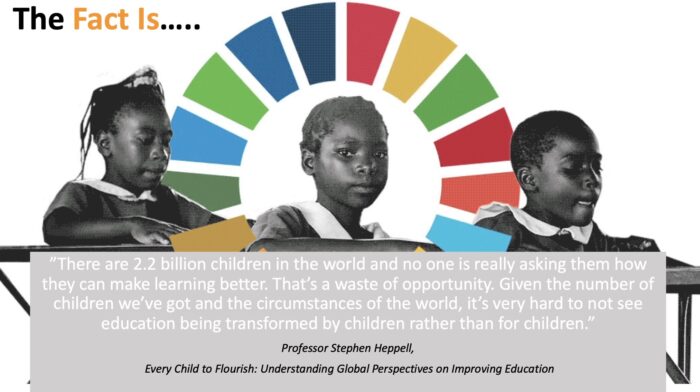
Children and young people under 18 make up more than 25% of the global population, but they are rarely consulted on their education.

So the World’s Largest Lesson teamed up with NetApp, a cloud-led, data-centric software company. Our mission: to help students speak up for SDG 4: Quality Education using the power of data!  

SO WE CREATED SOME LEARNING RESOURCES…

This video introduced the campaign to students:


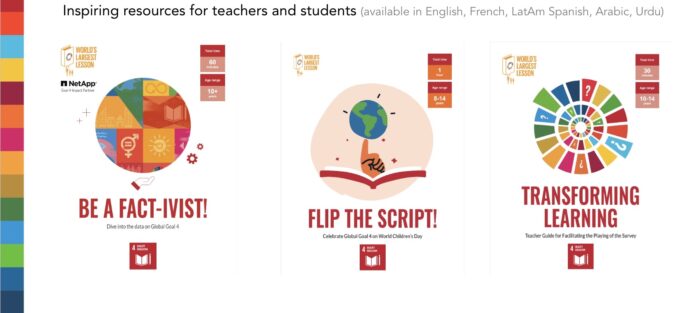
We created three World’s Largest Lesson resources for the educators in our network to use.  

Be A Fact-ivist! 

An SDG 4 data project where students learn how to handle data, identify the facts and take creative action 

You can see more of these here.

Flip The Script!

A lesson inviting students to take action for SDG4 by designing their own lesson and teaching it to others for World Children’s Day.

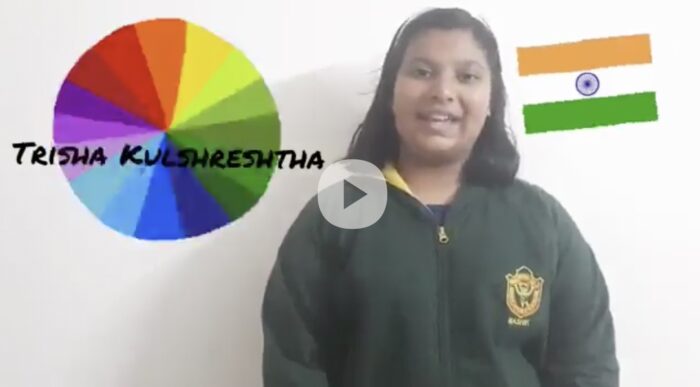
Check out Trisha’s lesson on the magic of maths!


Transforming Education Survey

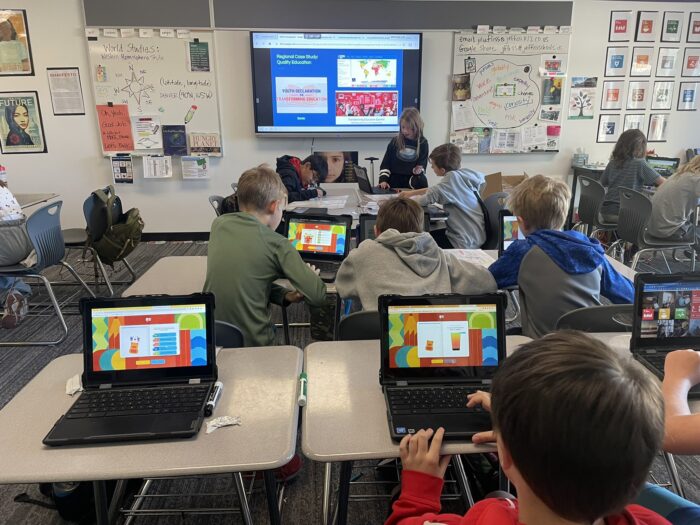
A gamified survey for students aged 7-18 years old from around the world to share their views and ideas about education and how they think it should be transformed.

WE CHALLENGED LEADERS TO LISTEN TO STUDENTS…

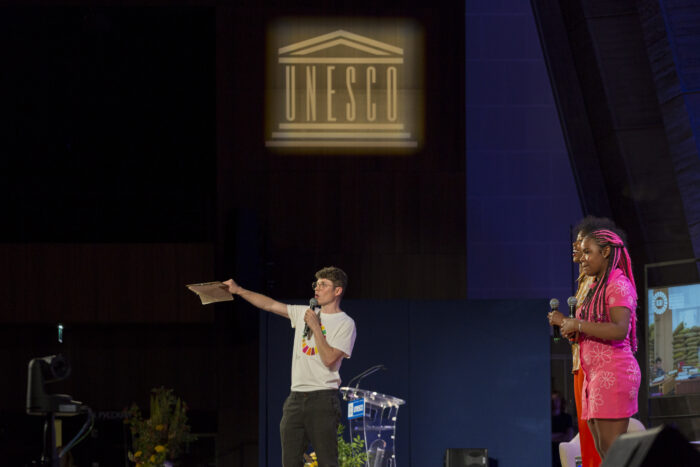
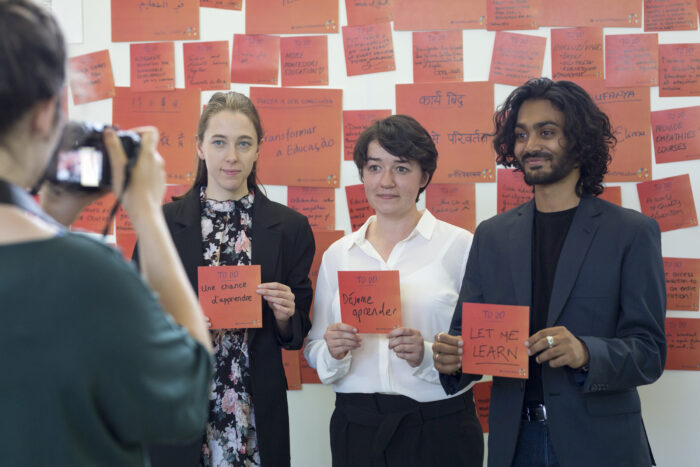
Transforming Education Pre-Summit, Paris

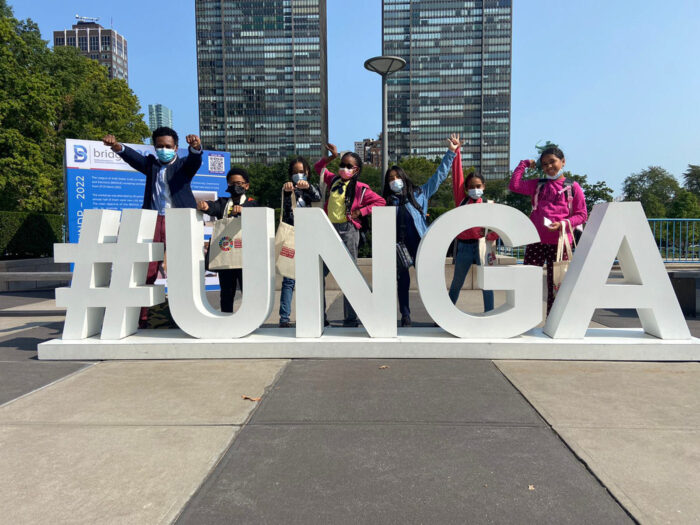
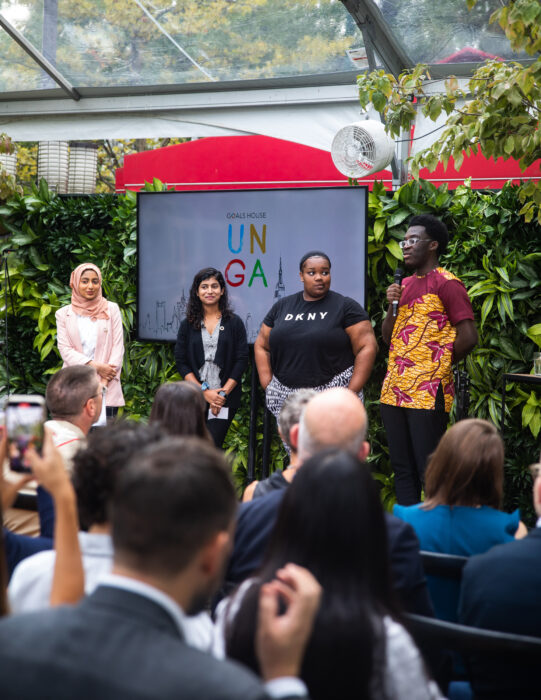
Transforming Education Summit and Student Voices at UNGA, New York

You can watch a short recap video here.


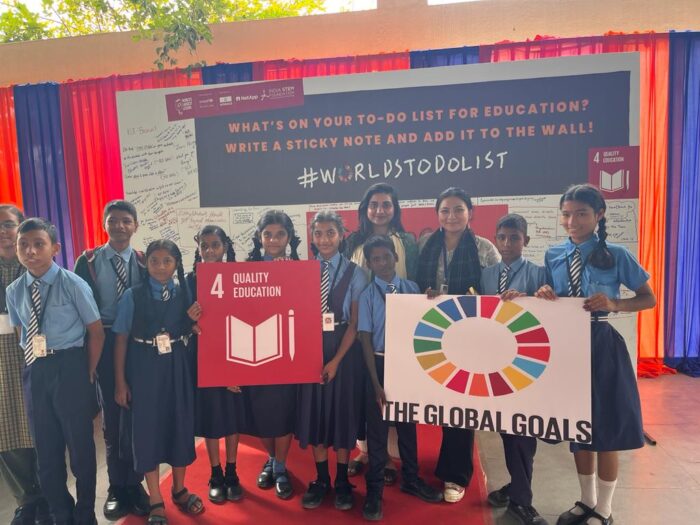
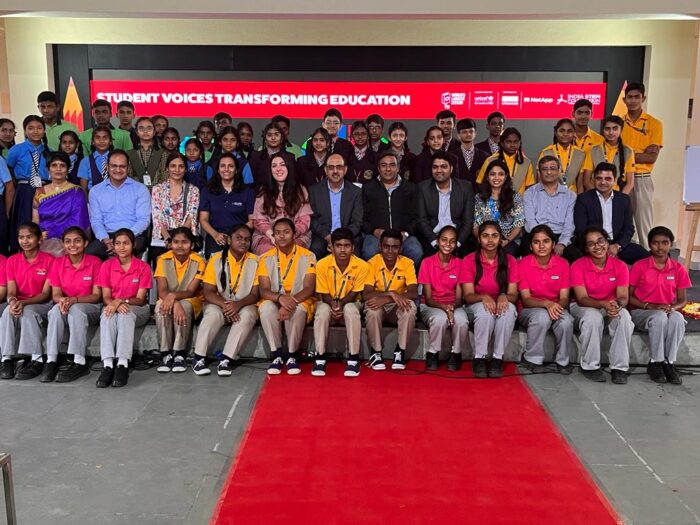
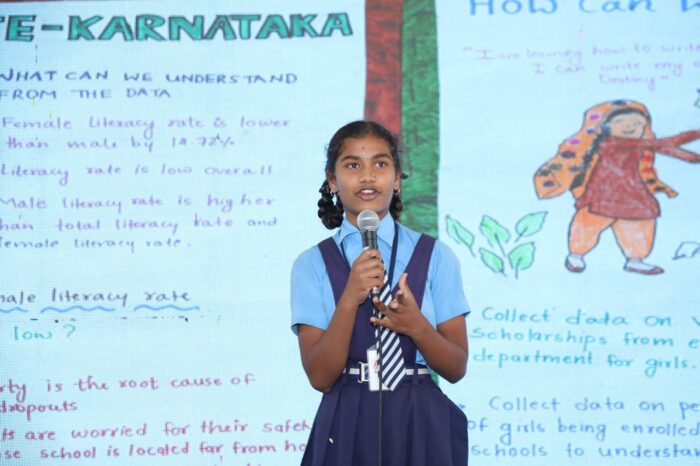
Student Voices, Bangalore

 You can watch a short recap video here.

HERE’S WHAT THE YEAR LOOKED LIKE!

Thank you to all the amazing educators around the world who made this possible.

…AND NOW, THE SURVEY RESULTS ARE IN!

On International Day of Education we closed the Transforming Education Survey.

  •  37,000 students took part
  • From 150 countries 
  • Sharing 25,000 ideas to transform education!


The report shows how important it is that we all understand what data is and how to use it. Our data is powerful! We learned that…

Read the report to find out more!

WHAT’S NEXT?

Students have spoken, now it’s our turn! We’re working hard to deliver students’ views to education leaders at the UN and in countries, to make change happen. 

That means delivering the report to leaders at UNICEF and UNESCO, national governments and education organisations worldwide. It means sharing the findings at key education events, with educators and decision-makers at all levels. It means challenging leaders worldwide to ask students what they think about education in their countries.  


Meanwhile, NetApp are continuing their work to help students learn data literacy skills for the future, through their Data Explorers program, so that young people can harness the power of data to change the world. 

When it comes to transforming education, children and young people have so much to offer. Governments must consult and include children in their decision-making, so that education reflects those that it serves. 

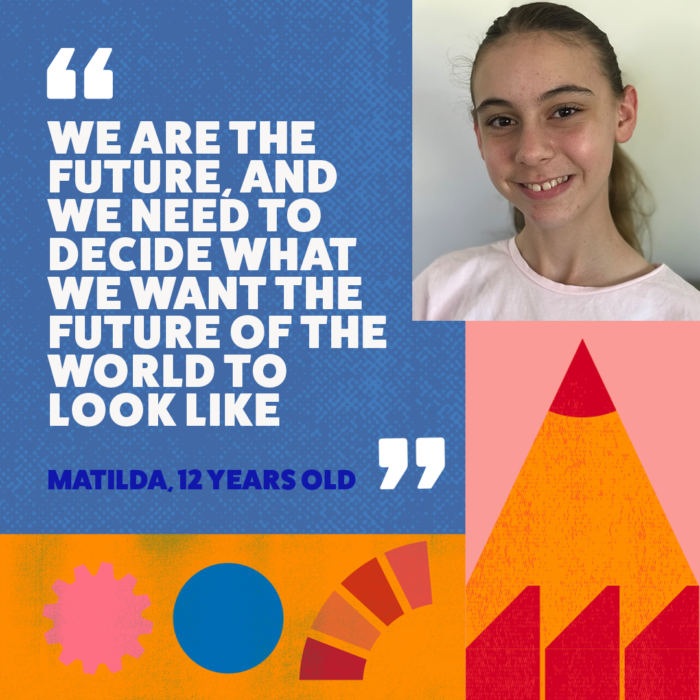
As Matilda, 12, World’s Largest Lesson Student Advisory Panel member in Australia put it:


THANK YOU!

Thank you to our incredible partners NetApp, UNICEF and UNESCO and the amazing team at Play Verto who created the digital and paper-based survey and designed our report. 

Thank you to every student who has taken part and proven that you deserve a voice on education. 

And to every educator that is bringing our resources to life in your schools and settings – all we do is thanks to you!

Global Survey of 37k School Students Reveals Desire to Modernize Education

World’s Largest Lesson Gives Voices to Students in One of The Largest Global Education Surveys Ever


March 15th 2023. The World’s Largest Lesson – an initiative led by Project Everyone and UNICEF – and NetApp a cloud-led, data-centric software company, today announce the findings from one of the largest global surveys of education ever which garnered 37k responses from young people in 150+ countries, many sharing their views for the first time.

The gamified survey revealed an overwhelming call for a modernization of curricula to mirror more closely the realities, skill sets and demands of today’s society and the future.
 The Reality

When students were asked what they believe the purpose of school should be 48% of responses related to gaining practical skills for the real world. However, the reality of their education does not reflect this.

“We’re in the middle of a global learning crisis, ” says Alison Bellwood, Executive Director of World’s Largest Lesson. “Students are imagining a future that is very different from the one their current curriculums were developed for. They want to be ready to thrive in new, green economies and to help build a sustainable world. Children have spoken. It’s the responsibility of education policy makers to listen to them.”

The good news is that 77% of students are happy to be back at school after COVID-19, and they’ve shared thousands of ideas about what they want to see changed in education.

The Future of The Education is Practical Skills

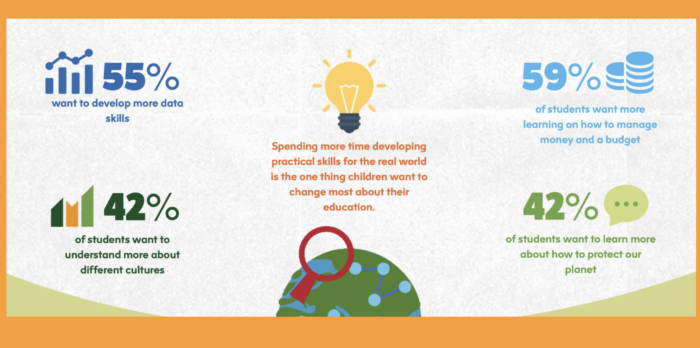
When asked whether they were learning enough about a range of topics, 61% of students worldwide said they feel they are learning not enough or not at all about digital skills like programming and coding. A close second with almost 59% calling for financial literacy or how to make a budget with 55% wanting to understand how to analyse and use data.

“In today’s world, it has never been more critical for data literacy skills to be taught in classrooms,” Michelle Mann, Director, Social Impact at NetApp. “Data is, increasingly, the foundation for informed decision making around so many important social, technological, and environmental issues—including a child’s own education. NetApp is committed to helping empower student voices and ensure leaders make room for them in educational discussions so they can share data-informed insights on how they would like to learn.”

To address the need for data science learning experiences, NetApp created a global social impact program call Data Explorers. It’s a hands-on afterschool program focusing on reaching under-represented students in under-resourced communities.

Understanding Mental Health, other Cultures and the Environment

While being prepared for jobs and the future were top of mind, a further 44% wanted to learn more about how to look after their mental health and wellbeing, with 33% reporting they feel anxious to be back at school after COVID-19. 42% of students reported wanting to understand different cultures, and a further 42% wanted to learn more about how to protect the planet.

Tanishi, 14, a member of the World’s Largest Lesson Student Advisory Panel member based in India, said “Asking what young people want from their education is the first step of change. It is similar to what the marketing division of a business does when they research what their customers want… If the customers here are students, to make their education more efficient and helpful, asking students about what they want from education is essential.”

Global Voices, Shared Needs

When asked for ideas on how to change education, the most common global theme was practical skills attainment, at 33% and a further 21% mentioned being more informed on key issues. As one student put it “It is important to study the past, I know, but now we are living in the present and I want to know how to live in this world”.

Nearly 20% talked about changing how they learn, for example reducing pressure to succeed in exams or allowing students more individual choice. One student said “This egg-carton model impedes professional growth and change”. Another said “I would reinvent the relationship with my teachers: today they act as they were ’superior’ while they should act as our mentor”.

Call to Action

While we’ve heard calls to modernize education before, this survey has allowed children themselves to speak up and add their voices, many for the first time. Together they’ve shared more than 25 thousand ideas of their own to transform education, from “allow students to choose the subjects they want to study” and “study in nature” to “being able to experiment” and experience “life learning lessons”.

Could this be the tipping point to a bold redirection of education? If so, the report argues that governments must consult and include children in their decision-making, so that education reflects those that it serves. As Matilda, 12, World’s Largest Lesson Student Advisory Panel member in Australia put it, “We are the future, and we need to decide what we want the future of the world to look like”.

Read the Transforming Education Survey report: https://playverto.com/transformingeducation


###


Notes to Editors

For more information please contact:

Kinvara Jardine Paterson, Director – World’s Largest Lesson [email protected]
Casey Stickles, Director – Stickles PR  [email protected]


About the Transforming Education Survey

In 2022, World’s Largest Lesson and NetApp launched the Transforming Education Survey globally. They worked with Play Verto, experts in designing playful interactive data experiences, in the creation of the survey.

The survey invited children and young people aged 10-18 around the world to share their views and ideas on education. It asked questions about how they felt COVID-19 had impacted their learning, what they like about their education and what they’d like to change. The survey is one element of World’s Largest Lesson 2022 created to help children and young people, aged 10 and above, become activists for SDG4: Quality Education.

Methodology

  • The survey ran publicly from 16th August 2022 until 24th January 2023, International Day of Education.
  • They survey was completed by more than 37,000 students in 150 countries.
  • The survey was gamified, available online and offline for those without internet access.
  • The survey was available in English, French, Spanish, Urdu, Arabic, Hindi, Russian, Portuguese and Korean. It was completely anonymous.
  • The survey received equal representation in responses from children in the Global South and the Global North.
  • The top 5 countries with the highest number of responses were: India, Nigeria, USA, UK and Mexico.

About World’s Largest Lesson

The World’s Largest Lesson is committed to introducing children and young people everywhere to the Global Goals, or SDGs. World’s Largest Lesson is delivered in partnership with UNICEF, with the support of UNESCO, along with many other NGOs, private sector organizations and foundations. Learn more here.


About NetApp and Data Explorers

NetApp is a global, cloud-led, data-centric software company that empowers organizations to lead with data in the age of accelerated digital transformation. The company provides systems, software and cloud services that enable them to run their applications optimally from data center to cloud, whether they are developing in the cloud, moving to the cloud, or creating their own cloudlike experiences on premises. With solutions that perform across diverse environments, NetApp helps organizations build their own data fabric and securely deliver the right data, services, and applications to the right people—anytime, anywhere. Learn more at www.netapp.com or follow us on Twitter, LinkedIn,Facebook, and Instagram.

NetApp Data Explorers is a global social impact program with a mission to empower teens to discover and develop critical data science skills, preparing them to thrive and take action in a data-driven world. Learn more about Data Explorers.

NETAPP, the NETAPP logo, and the marks listed at www.netapp.com/TM are trademarks of NetApp, Inc. Other company and product names may be trademarks of their respective owners.


About the partnership

In 2022 the World’s Largest Lesson joined forces with NetApp to empower children to act for education (SDG 4) using the power of data.


About the Global Goals for Sustainable Development (SDGs)

The Sustainable Development Goals or Global Goals are a collection of 17 interlinked global goals designed to be a “blueprint to achieve a better and more sustainable future for all”. The SDGs were set up in 2015 by the United Nations General Assembly and signed by all 193 member states. They are intended to be achieved by 2030. Learn more here.


About Global Goal 4: Quality Education

Sustainable Development Goal 4 is about quality education and is among the 17 Sustainable Development Goals established by the United Nations in September 2015. The full title of SDG 4 is “Ensure inclusive and equitable quality education and promote lifelong learning opportunities for all”.

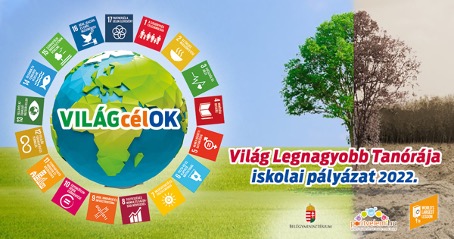
THE WORLD LARGEST LESSON IN HUNGARY: the 8th edition

The 2022 World’s Largest Lesson in Hungary was organized for the eighth time by PontVelem Nonprofit Kft. between 3th and 7th October 2022, on behalf of the Ministry of the Interior as project manager, with the professional support of the Hungarian National Committee of UNESCO, the UNICEF Hungarian Committee and the National Council for Sustainable Development.

This year nearly 600 Hungarian schools with 15 000 pupils have registered for the program series of WLL.

The program was linked to the European Sustainable Development Week (ESDW), which took place between 18th September and 6th October 2022. The purpose of the series of events is to promote sustainable development and global sustainability goals with the broad involvement of society. The coordinating organization of ESDW in Hungary is the National Sustainable Development Council.

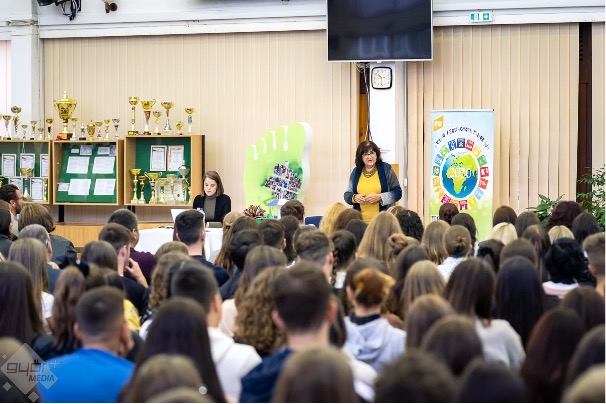
The press opening event of the WLL took place the week before the program week, on the 30th of September 2022, between 10:00 a.m. and 12:00 p.m. at the Győr SZC Baksa Kálmán Bilingual High School. According to tradition, the opening interactive lesson for students aged 14-18 was held by an internationally well-known sustainability specialist, Katalin Czippán, who dedicated to the topic.

More than 300 students participated in the lesson personally, and several thousand students followed the lesson online – as the lesson was streamed live throughout the entire Carpathian Basin. Katalin Czippán talked about the individual responsibility in reducing sustainability problems, and she also answered questions from the students. The opening lesson is available online (only in Hungarian). Another important event related to the opening event was the II. Győr Climate EXPO.


The organizers helped teachers participating in the WLL with online webinar training and a teacher’s guide containing some methodological steps of the program. The success and quality of the program were measured by a teacher questionnaire at the end of the program series.

UN experts prepared different lesson plans and additional teaching aids for the highlighted topics of the WLL. These documents were available for all teachers in English and Hungarian in online downloadable form, furthermore, the authors of the Hungarian Green Earth textbook about sustainability also supported the program with relevant lesson plans. The lesson plans are only available online and can be downloaded from the website, they are printed locally at the school.

The main topic of the WLL in 2022 was Nr. 4. Quality education. On this topic, lesson plans for 3 age groups were available to teachers in Hungarian. In addition to these, lesson plans made in previous years of the World’s Greatest Classroom can also be used. The lesson plans recommended for 2022 were available from September 2022.

WORLD GOALS APPLICATION 2022.

At the competition announced as part of the WLL in 2022 can participate students from any primary and secondary school in Hungary and abroad registered for 2022 WLL the competition. It is possible to participate in a community activity that serves one of the Global Goals announced by the UN in 2015 or even several Goals that can be implemented at the local level. The schools can choose from specific topics or implement their ideas.

Entries can be submitted in 3 age categories:

1-4. grade
5-8. grade
9-12. grade

A total of HUF 900,000 will be awarded to the students who submitted the best entries selected by the professional jury. The best entries will be published on the Hungarian website of the World’s Largest Lesson.

World’s Largest Lesson Launches Global Student Survey

Embargo: 08:00 ET Tuesday 16th August  

New York, 16th August 2022. The World’s Largest Lesson – an initiative led by Project Everyone and UNICEF – today launches a global gamified survey inviting children and young people to share their views on the current state of education and how it can be transformed to meet the needs of today’s schoolchildren.

Lack of resources, poor quality teaching and materials, outdated curricula, and more than two years of education disruption caused by the COVID-19 pandemic have created the perfect storm for a global learning crisis. A predicted 70 per cent of children in low- and middle-income countries are unable to read and understand a simple text by age 10 – a marker for minimum literacy proficiency, up from 57 per cent pre-pandemic.

To address this, education systems must be reformed, and children and young people must be consulted in the development of education policy plans.

The World’s Largest Lesson survey created with the support of NetApp, a cloud-led, data-centric software company, will help provide governments with the data they need to do this.

In response to the global learning crisis, the United Nations is hosting the Transforming Education Summit in New York on 19th September 2022 and is asking governments to include children and young people on an on-going basis in their education policy plans.

Alongside the summit, World’s Largest Lesson and NetApp are inviting students to present their ideas for the transformation of education to a group of business, education, and policy leaders at Goals House on Monday 19thSeptember in New York. The ideas presented will then be shared with other children to encourage them to develop and share their own innovations for education.

The survey is one element of World’s Largest Lesson 2022 created to help children aged 10 and above become education activists for SDG4. There are many opportunities for children to get involved including by using data to spark their action on education to teaching their own ideal lessons at school on World Children’s Day on 20thNovember. The survey will run until January 2023, following which a full report of the findings will be published.

“Data has become a critical resource for driving digital transformation in our interconnected world,” said George Kurian, NetApp, Chief Executive Officer. “At NetApp, we believe in empowering the next generation with the data science skills to build the future. This year, through our Data Explorers program, we are proud to support the World’s Largest Lesson, a program of Project Everyone, working in partnership with UNICEF and with the support of UNESCO. Together with the World’s
Largest Lesson, we seek to prepare today’s young people to unlock the full potential of data and make a difference in tomorrow’s world.”

-Ends-


Notes to Editors


For more information please contact:

Casey Stickles – Stickles PR

[email protected]


About World’s Largest Lesson

The World’s Largest Lesson is committed to introducing children and young people everywhere to the Global Goals, or SDGs. World’s Largest Lesson is delivered in partnership with UNICEF, with the support of UNESCO, along with many other NGOs, private sector organizations and foundations. Learn more here. 
 

About NetApp and Data Explorers

NetApp is a global, cloud-led, data-centric software company that empowers organizations to lead with data in the age of accelerated digital transformation. The company provides systems, software and cloud services that enable them to run their applications optimally from data center to cloud, whether they are developing in the cloud, moving to the cloud, or creating their own cloudlike experiences on premises. With solutions that perform across diverse environments, NetApp helps organizations build their own data fabric and securely deliver the right data, services, and applications to the right people—anytime, anywhere. Learn more at www.netapp.com or follow us on Twitter, LinkedIn,Facebook, and Instagram.
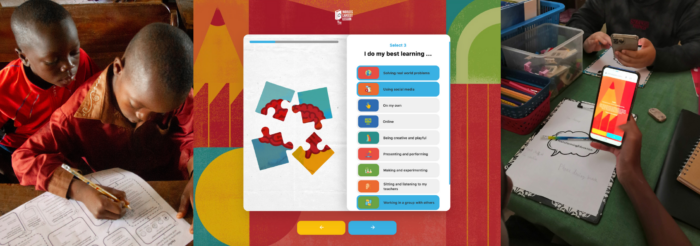
NetApp Data Explorers is a student learning journey filled with exploration, investigation, and problem solving with social issue data.  Learn more about Data Explorers

NETAPP, the NETAPP logo, and the marks listed at www.netapp.com/TM are trademarks of NetApp, Inc. Other company and product names may be trademarks of their respective owners.


About the partnership

This year the World’s Largest Lesson is joining forces with NetApp to empower children to act for education (SDG 4) using the power of data.


About the survey

World’s Largest Lesson worked with Play Verto, experts in designing playful interactive data experiences, in the creation of the survey.  The survey is available to play both online and offline and is for children aged 10 and above.

The survey is designed to be facilitated as a learning experience to children via their classroom teachers. It is available from today (12th August) and will close on 10th January when a full report will be made available and published on 24th January 2023.

The survey is currently available in English, French, Spanish, Urdu, Arabic, Hindi, Russian and Portuguese.

Playing this survey is an opportunity for children to share their views and opinions and it is completely anonymous. No personal information is stored, and children can skip questions or opt out entirely if they do not wish to participate.


About the Global Goals for Sustainable Development (SDGs)

The Sustainable Development Goals or Global Goals are a collection of 17 interlinked global goals designed to be a “blueprint to achieve a better and more sustainable future for all”. The SDGs were set up in 2015 by the United Nations General Assembly and signed by all 193 member states. They are intended to be achieved by 2030. Learn more here.


About Global Goal 4: Quality Education

Sustainable Development Goal 4 is about quality education and is among the 17 Sustainable Development Goals established by the United Nations in September 2015. The full title of SDG 4 is “Ensure inclusive and equitable quality education and promote lifelong learning opportunities for all”.

Sign Up

Join the World’s Largest Lesson educator community!